Wednesday, 8 October 2014

The Kashmir Conflict

Kashmir is a long standing area of dispute between India and Pakistan. This has been the case since the end of British rule in India, in 1947.

Kashmir had been a state within the region, and although having a predominately Muslim population, was ruled at the time by the Maharaja Hari Singh, who was a Hindu ruler.

However, with the end of British rule, Kashmir and the Maharaja was faced with an important decision. It could either choose to be an independent state, or annexe with India or Pakistan.

Pakistan expected Kashmir to become part of their territory, due to Pakistan being the new Muslim country and Kashmir being predominantly Muslim. However at first, the Maharaja made the decision to remain neutral. This impartiality did not last long. In October 1947, Kashmir was at a large threat from revolutionaries and Pakistani tribesmen sent to infiltrate the capital of Srinagar.
Signing of Instrument of Accession, 1947

With Kashmir vulnerable, the Maharaja turned to India for military assistance. Fleeing to India, the Maharaja signed the Instrument of Accession on 26 October 1947, relinquishing Kashmir territory to India.


This conflict of territory would lead to the Indo-Pakistan War of 1947, 1965 and 1971. The Kargil War also occurred in 1999, which led to the intervention of the US to pressure Pakistan to retreat. Through this time it has led to the current situation, with India occupying two-thirds of the territory, Pakistan having northern areas and China occupying eastern regions after making claims in the 1950s. 

The significance for today:
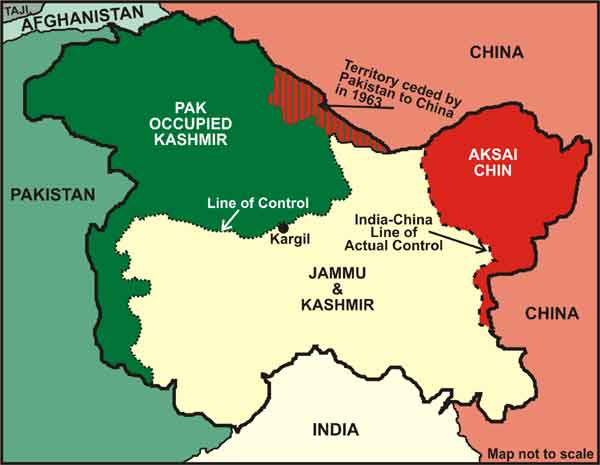
Areas of Occupation in Kashmir
Conflict continues to persist in Kashmir today, and is often seen as the forgotten conflict to the Western world. 

It has affected the current global situation enormously. Osama bin Laden stated in his 2002 letter to the US that one of the reasons he was fighting America was due to its decision to support India in the Kashmir issue. The situation in Kashmir is also becoming more drastic due to the nuclear threat that persists, with both Pakistan and India gaining nuclear powers. As well as this, Amnesty International have brought to light the huge violation of human rights in Kashmir today. There are countless cases of human rights violation from India, including detentions, curfews, rape and torture, which India denies. Over the years, too many to count have died due to this conflict, which continues to persist today. Only today, have 16 people been killed due to violent clashes, in the village of Mahashay Kothe.  (http://www.bbc.co.uk/news/world-asia-india-29532066)

Even though this is one of the many conflicts that exists in our global society, it is a conflict that has seen horrors for nearly 70 years. This disputed territory, that began with the Maharaja Hari Singh has led to numerous wars and devastated the lives of Kashmiri people. With 43% of Kashmiri people seeking complete independence and 50% of Azad Kashmiri's wishing to join Pakistan, the end of this conflict, unfortunately, sees no end in sight. 

THIS BLOG claims no credit for any images posted on this site unless otherwise noted. Images on this blog are copyright to its respectful owners. If there is an image appearing on this blog that belongs to you and do not wish for it appear on this site, please E-mail with a link to said image and it will be promptly removed.

Wednesday, 3 September 2014

The Bangladeshi Liberation War (1971)

By 1972, three individual countries, Bangladesh, India and Pakistan, would emerge from what had been, in 1946, one country, India.

After Britain left India in 1947, India was divided into two individual countries, Pakistan and India. It was agreed, due to religious tension, that Pakistan would to be the home of the Muslims and India was for the Hindus. However the areas which were known as Pakistan were divided, each separated, being on the east and west of India. Pakistan was therefore divided into areas known as West and East Pakistan.
However it would soon become clear that although both East and West Pakistan were of the same country, there was a significant difference between them.

It was clear that the political power was concentrated in West Pakistan, whereas East Pakistan was exploited economically and politically ignored. For example between 1950-55, 11,290 of Pakistani rupees was spent in West Pakistan whereas only 5,240 Pakistani rupees were spent by the government in East Pakistan. West Pakistan continuously began to receive more money, even though East Pakistan had a much larger population  All power remained with West Pakistan, and any idea of political power in East Pakistan was ignored. As the differences and exploitation became realised by those in East Pakistan, discontent began to rise, and the East Pakistanis began to fight back against the unfair ruling.

Although resistance in East Pakistan, or Bangladesh as it began to recognise itself as, was scattered at first, it quickly began to organise itself as the Pakistani suppression increased. East Pakistan demanded their separation from West Pakistan, but this was denied. The Bangladeshi Resistance, the Mukti Bahini (which many of my own family members had been a part of), grew in numbers as the Pakistani suppression, Operation Searchlight began.

Operation Searchlight enforced much violence in Bangladesh, causing the Mukti Bahini to fight back, and the beginning of the Liberation War on 26 March 1971. Operation Searchlight was violent, and began systematic killings and acts of genocide, with 3,000,000 casualties for Bangladesh as a whole. The Operation's aim was to attempt to curb Bangladeshi nationalism and destroy all opponents. Universities in Bangladesh were also targeted, with the residential halls of Dhaka University being destroyed. The Hindu residential hall was also unfortunately targeted and massacred, with up to 700 students murdered by Pakistani forces. It is  now recognised that the acts taken by the Pakistani forces in Bangladesh during the Liberation War were acts of genocide.

The Surrender of Pakistani Troops
Pakistan grew wary of the idea of India's involvement and so launched pre-emptive strikes on northern India. However, this caused India to enter the war on 3 December 1971. With India now involved in the war, and Pakistan fighting two fronts, it became increasingly difficult on their part. Eventually on 16 December 1971, Pakistan surrendered to India and Bangladesh. It was the largest surrender since World War II, with Pakistan surrendering 93,000 of its troops to the Liberation forces. These troops were taken as prisoners of war by the Indian Forces.  The surrender of Pakistan was enabled by the signing of the Instrument of Surrender.


The Signing of the Instrument of Surrender
Later on, the Simla Agreement was signed between India and Pakistan in 1972. This ensured the recognition of Bangladeshi independence by Pakistan in return for their prisoners of war. Bangladesh sought recognition by the UN, and was admitted. The USA  and China were one of the last countries to recognise Bangladeshi independence, having been a Pakistani ally during the Liberation War.


Having recently visited Bangladesh, although with many of the older generation Pakistani-Bangladeshi tensions still exist, I feel Bangladesh has moved forward greatly. The success of the Liberation War is for many Bengali's today the foundation of their country's pride.

THIS BLOG claims no credit for any images posted on this site unless otherwise noted. Images on this blog are copyright to its respectful owners. If there is an image appearing on this blog that belongs to you and do not wish for it appear on this site, please E-mail with a link to said image and it will be promptly removed.

Saturday, 16 August 2014

The Black Death in England (1348-1350)

The Black Death was one of the most severe pandemics in the history of England and the world. In England, it would go on to wipe out nearly half of its population between 1348 and 1349. It would also go on to reach England's shores another six times after this.

The Black Plague reached England in 1348. It would start with a severe headache and a fever. Then may come vomiting, back pain and a soreness in the limbs. Soon burning lumps would appear that would turn black, and ooze blood and pus. In most cases, death would soon follow, within around three days.

It has been thought previously that the disease was caused by rats that carried fleas that could infect a person with this plague. However, very recent evidence that has been acquired from human remains found in north London suggest that fleas were not responsible. Scientists have gathered that the plague spread quickly, far too quickly for the cause to be fleas carried by rats. Instead it is now widely believed amongst academics that the bubonic plague was spread by 'droplet infection' also known as coughing and sneezing.

How did the Black Death reach England?


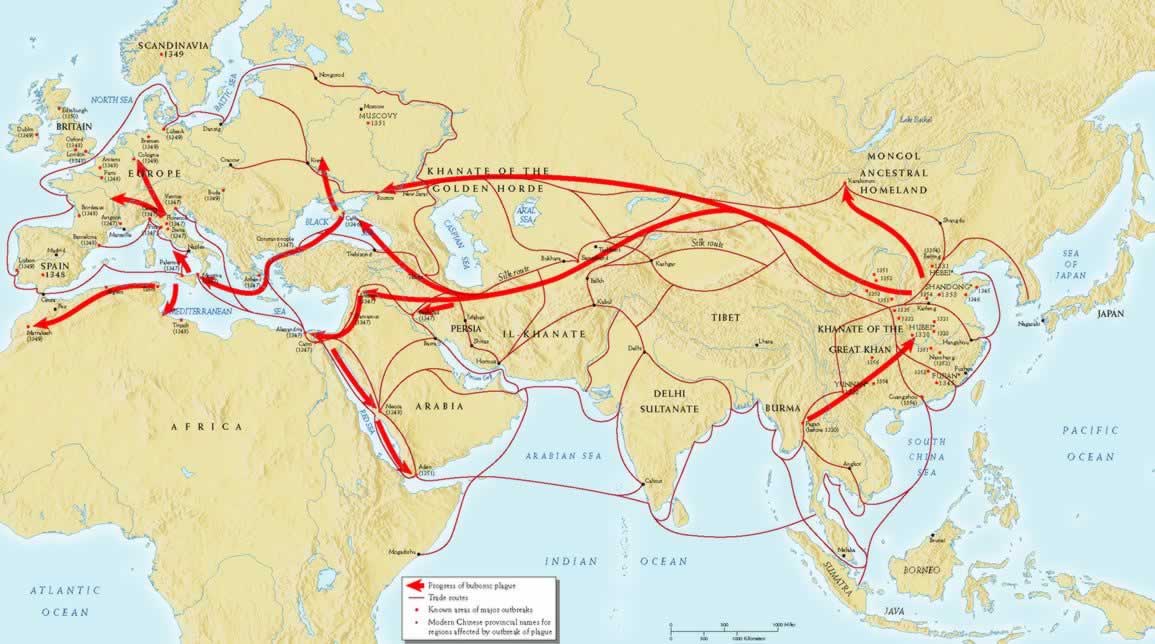
The Spread of Black Death
It is believed that the bubonic plague originated from China and other areas of Asia. The first appearance in Europe was in Sicily in the autumn of 1347. The plague travelled mostly by the trade routes, passing from traders that had contracted the plague. This assured the quick spread of the plague.

How did the English respond to the Black Death?

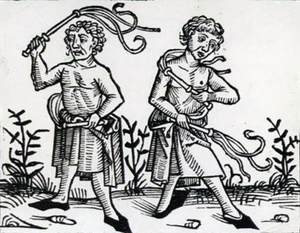
In this time period, there was an incredible lack of medical knowledge. This meant that the people would try anything to escape contracting the disease. Some of the most extreme and ludicrous was for example, witchcraft. Many believed that you should place a live hen next to the swelling to draw out the disease from the body. Then, for recovery, drink two glasses of your own urine twice a day. Others, the flagellants, believed that they should show their love for God, so in order to escape the disease. They would show their love by whipping themselves, in the hope that they would be spared. 

Flagellants
The Consequences of the Black Plague

The most immediate consequence of the Black Plague was that due to the high mortality rates, there was a shortage of labour. Those who survived the Black Death believed that they were special and so proceeded to attempt to improve their life after the Black Death had died out. Many peasants demanded higher wages or attempted to leave their villages, even though Feudal law stated peasants could only leave their village with their lord's permission. However many lord's would allow this, so the peasants could go and work for them. The peasants, aware of the shortage of labour, used this to increase their wages. 

The government introduced The Statute of Labourers in 1351 in an attempt to control this constant peasant movement within the countryside. This Statute said that no labourer was to be paid above the wage that they received in 1346, before the plague. Also, no peasant was allowed to permanently leave the village they belonged to. 

These repressive measures enforced by the government led to a build up of anger. This would eventually contribute to the Peasants Revolt in 1381. This Revolt would end up with the burning down of Savoy Palace and the killing of both the Chancellor and the Treasurer. The abolition of serfdom was demanded by the peasants, which was eventually granted. 

The Black Death would appear once again in England. It was last seen in England in what is known as the Great Plague of London, 1665-66. 

THIS BLOG claims no credit for any images posted on this site unless otherwise noted. Images on this blog are copyright to its respectful owners. If there is an image appearing on this blog that belongs to you and do not wish for it appear on this site, please E-mail with a link to said image and it will be promptly removed.


Thursday, 24 July 2014

Women in the Early Soviet Union

In Russia's past many peasants had claimed the right to beat their wives, with one proverb saying "The more you beat the old women, the tastier the soup will be." However, when the Soviet Union formed in Russia after the failure of its Provisional government, the new Communist state was to make changes to the position of women in its society.

Alexandra Kollontai, a Marxist who was a committed Bolshevist dominated what was known as 'the woman question.' One of her beliefs was that women should be independent and work outside of the home should be a large part of a woman's life. According to Kollontai, capitalism at the time oppressed women with the burden of both housework and work outside of the home. Lenin agreed with Kollontai and saw the traditional bourgeois marriage as a form of slavery. 

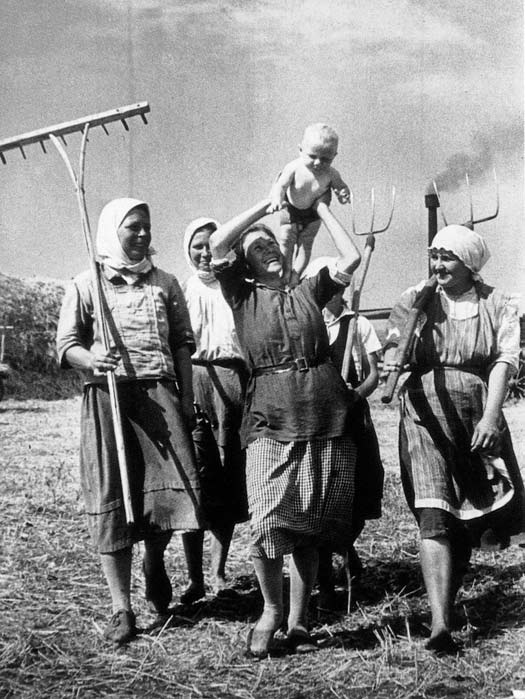
The People's Commissar for Social Welfare passed laws which would create a change in the position of women in society, lessening their importance as merely homemakers but also those who are able to work. For women who were pregnant there became guaranteed paid maternity leave for two months before and after the birth. Mothers with young babies were also allowed shorter hours and allowed time to specifically look after their babies. A commission was also set up to protect mothers and infants that made plans for maternity clinics, milk points and nurseries. These changes showed that the Communist state was attempting to make it easier for women to work rather than be merely homemakers. 
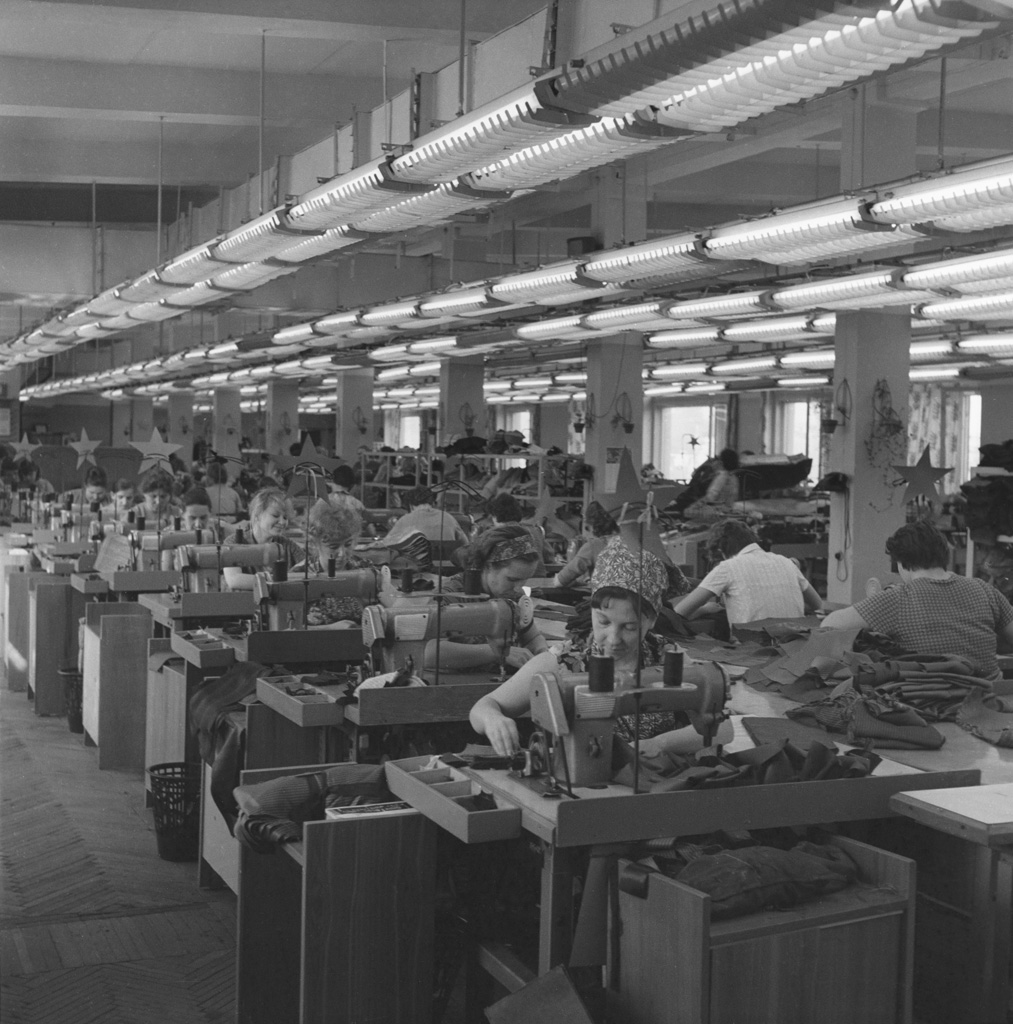
Working Women in the Soviet Union
Also to create a change in women's role in the home, change needed to be made to the bourgeois constraints of marriage. A new divorce law was passed that stated that either the husband or the wife could terminate a marriage on their own grounds. This made divorce much easier that it had been previously and the hope was that this would provide women with more freedom in their lives. However this Communist dream did not work quite as well in reality. By the mid-1920's, the USSR had the highest divorce rate in Europe, approximately 25 times higher than in Britain. It did not work in reality as it left women in a state arguably worse than prior to the changes of divorce laws. Now, women were easily left by their husbands, with many of the women being left pregnant, and many men and women reportedly marrying up to 15 times. In 1927, surveys showed that almost two-thirds of marriage at the time ended in divorce. 

As well as changes to divorce laws in the effort of changing women's status, there was also changes to abortion laws. A law was passed that allowed abortion to be performed under medical supervision and the USSR was in fact the first country to legalise abortion on demand. This is a huge change to the previous Tsarist Russia's image of 'backwardness.' This law was passed in the hope that women would be able to focus more on working rather than the traditional role of women. By the early 1930's there was around 1.5 million abortions per year. In 1931 abortions massively exceeded births with there being 21.3 births per thousand of the population and 36.3 abortions per thousand of the population. 

However in the 1930's the Soviet Union may have realised that although for many good, their ideas for women were possibly at the time, far reaching. The 1930's saw a retreat to the old Russian family values. The Soviet state had realised that their previous policies had radical impacts that could not be dealt with at the time. Changes were made that only allowed abortion if there was a threat to a woman's life and divorce was made harder, with the fee for divorce being raised to 50 roubles for the first divorce, 150 for the second and 300 roubles for any subsequent divorces. 

Although the policies made by the USSR in favour of women's status are accepted in much of today's Western society it appears that at the time they were policies that were far-reaching. Many women in the Soviet Union saw an improvement in their status, but the USSR was not quite ready for its desired radical change.

THIS BLOG claims no credit for any images posted on this site unless otherwise noted. Images on this blog are copyright to its respectful owners. If there is an image appearing on this blog that belongs to you and do not wish for it appear on this site, please E-mail with a link to said image and it will be promptly removed.
Wednesday, 16 July 2014

History: A Story of Progress?

After attending a History taster course at SOAS recently, the lecturer, Angus Lockyer, raised the question that is an incredibly common question for those studying history to ask. Is History a story of progress? My opinion? No.

Those who see history as a story of progress can be seen as 'whiggish.' The term 'whiggish' or 'whig' comes from those in Britain that had supported a move away from the power of the monarchy  to the power of parliament and constitutional monarchy. They saw that an achievement of constitutional monarchy allowed British subjects political liberties and so therefore it was progress. However this is easily questioned. Why is parliamentary democracy seen as progress? For a whig to see this as progress is merely an assumption. The term 'whig' refers now to those who jump to the idea of constant progress in history. What we first need to ask ourselves is this, what do we mean by progress?

The definition of progress is "forward or onward movement towards a destination or goal." So to say History is a story of progress implies that there is a certain goal that humanity needs to reach by progressing.  There are certain ideals that most people see as progress, such as equality, freedom, advances in socio-economic statuses and technology. All this should be progress, however it is undeniable that the idea of progress is very much subjective. For example, extremist islamists may see progress as spreading Shari'ah law to other parts of the globe. Of course for most parts of the globe, this would be regression, as it would be a turn back on the positive change that has been made in society such as women suffrage in the world. Therefore, although there are ideas of what is progress that are ideal for all of society, the definition of progress is quite subjective and therefore the question cannot be answered identically for all. Progress in one persons view may not be progress for another.

Thomas MacCauley, writer of A History of England, adopts a rather whiggish view of History. MacCauley says that "the national wealth, during at least six centuries, [has] been almost uninterruptedly increasing" and we have "been exempt from evils which have elsewhere impeded the efforts." MacCauley takes this to be progress. He identifies the idea of progressive change throughout history that begins at the signing of the Magna Carta and the Revolution of 1688. Both of these movements reduced the power of the kings somewhat. He sees that the changes that have occurred in Britain in its history have mostly had a positive affect on Britain's progress. However, a huge flaw in MacCauley's argument is that he focuses on the history of Britain. A parallel idea of progressive change cannot be seen all over the world. For instance Burma, after it was annexed by the British actually saw what can be deemed as a regression in 1885. Removal of it's monarch, Thibaw, can be said to have destroyed the countries rice industries and  created political disarray that is still partly present today. Reduction of the power of a monarch in the case of Burma did not create any progress for Burma, against whiggish beliefs. Therefore it is difficult to say that history is a story of progress as this quite obviously does not wholly apply.

On account of what has been discussed, I hold the view that History is not a story of progress. Yes, positive change can be seen throughout the world, changes that should be seen as progress, such as the abolition of the slave trade. However the idea of progress is not universally held, that for many history is not a story of progress. Also, progress can be seen in the history of countries such as Britain, however the same idea cannot be said for other countries, such as Burma, that appear to have regressed over the years (if an assumption of the idea of progress is to be made.)If a jump to the facts is made, History is a story of progress. But if History is correctly analysed, as a whole, it is not a story of progress.


Tuesday, 1 July 2014

The Birth of Britain in Australia -1788

Around 1766, it was suggested that Britain should exploit Australia and its surrounding regions for its riches. Only after the loss of American colonies did it become a serious plan for the British, who now wanted to find alternative land to settle a new British colony. Australia was chosen to settle this new British colony, beginning in 1788. The plan was to send convicts, mainly those convicted of trivial crimes, but convicts who were skilled in a trade that would be useful in building up the infrastructure and new life of the colony.
It is a common misconception to believe that the colonization of Australia by sending British convicts was because of the overcrowding of the British prison system or as a severe punishment for their crimes. In fact, the British were at first reluctant to enslave the current Australian inhabitants,the Aborigines, and so sent convicts to help build the new colony. Before convicts fully completed their sentences they were sent to help colonise in exchange for their pardon, and were allocated a piece of land to work on in Australia.


On 13 May 1787, the First Fleet that would establish the British colony in Australia, left Portsmouth and set sail for Botany Bay. It consisted of 11 ships and approximately 1530 people, 736 of which were convicts.They eventually decided to place their settlement at Sydney Cove on 26 January 1788. This day is now known as Australia's National Day. The settlement was named after the British Home Secretary, Viscount Sydney.

Governor Phillip, who had been under command of the initial sail to Australia had complete authority of the new inhabitants of the colony.Phillips aimed to created harmonious relations with the prior inhabitants of Australia, while also reform the convicts of the new colony. The punishments for those convicts who disobeyed were harsh, with discipline including the likes of flogging (which involved lashes) or confinement.

Convicts were assigned to those settlers that had arrived in Australia free. In return for allowing the convicts to work for them and providing them with food, the land was given to the free settlers free of expense. Female convicts were given work as well with many going into domestic service for the soldiers or marines that had also travelled to colonise Australia. Many of the female convicts were also forced into prostitution alongside domestic service.However few of the first arriving convicts actually had the necessary skills required for colonization, making colonization only more difficult. Convicts that finished their sentence normally remained as settlers, taking upon convicts onto their own land.


Life for the new colonial inhabitants was difficult. The lack of understanding of Australia's seasons meant the initial attempts of farming and agricultural works failed. Many of the new convicts arrived in unhealthy states, but their health deteriorated only further due to the lack of sufficient sustenance and from the hard labour on the settlements. Supplies from overseas were low and so starting up agriculture was difficult. However the ships began to arrive more frequently to the Australian shores, reducing the huge isolating feeling that the inhabitants had. These ships brought supplies and improved conditions. In 1789, a former convict, James Ruse managed to successfully produce a wheat harvest. This was followed by many other successful harvests by other inhabitants and soon the colony was growing a sufficient amount of food for itself.

This was only the beginning of British Australian history. The British would go on to explore further into the regions of Australia and there would be future rebellions among the new inhabitants and the initial occupiers of Australia, the Aborigines. There would also be great injustice towards the Aborigines. Nonetheless it can be seen that the colonizing of the British in Australia gave birth to the Australia we now know today.

THIS BLOG claims no credit for any images posted on this site unless otherwise noted. Images on this blog are copyright to its respectful owners. If there is an image appearing on this blog that belongs to you and do not wish for it appear on this site, please E-mail with a link to said image and it will be promptly removed.


Monday, 30 June 2014

The Legacy of the Crusades

The Crusades had profound and lasting historical impacts. They had an enormous influence on the European Middle Ages such as European governments, Western advancements, trade, the Byzantine Empire, the future Islamic World and lay the future setting of antisemitism.

As Kings levied taxes and formed armies, much of the nobility population, in order to take part of the Crusades sold their serfs (land slaves) and land. The power of the Kings grew because as the nobles quickly lost their power over the land, the kings were able to create stronger central governments. With heavy taxation on trade, their wealth grew, and so with it their power.

The power of the European kings was not the only thing that progressed after the Crusades. Islamic knowledge of medicine and architecture grew and found itself in the western world after the end of the Crusade era. Arabic advances such as in Algebra and engineering were also transferred into the western worlds, leading to great advancements in many European universities, eventually leading to the Renaissance.

An Example of Islamic Art and Architecture


There was also military advancements after the Crusades. After many a long battle, and with deeper knowledge of defense tactics, castles in Europe developed from smaller wooden buildings to huge, strong, stone structures, much more well suited to defense.

The huge transportation of armies and equipment during the Crusades caused European trade to flourish. Local merchants in many areas were able to expand their areas of trade, as the ongoing transportation through their countries allowed for it. This increase in trade brought new, unknown goods to European shores such as spices, diamonds, the early developed gun powder, even oranges and apples. The Crusades prepared Europe to travel longer distances, especially with the incentive of new goods, so trade grew after the Crusades.

After the Crusaders took Constantinople in 1204, the Byzantine Empire fell eventually in 1453, having lost its previous power and strength. Constantinople had been the major city of the Byzantine Empire and the Fourth Crusade saw Constantinople conquered by the Crusaders, leading to its slow demise.

There was also an effect on the future Islamic World. For instance, the expressions 'Franks' and 'Crusaders' quickly became, in the Islamic World, expressions of disdain. To this day, many Muslim movements refer to Western involvement in the Middle East as a 'crusade.'The Crusades were not to be easily forgotten by the Islamic World, remembered as a violent rampage by European Christians.

There was also an effect on much of the Jewish community, although they were never really directly involved with the Crusades. During the Crusades there were many attacks on Jews in Europe, who were seen as anti-Christian, and regretfully, as some sort of enemy against the Christian plight. Huge atrocities were seen in the Crusade era against Jewish communities in German, Hungarian and French towns, while also in Palestine and Syria. These attacks during the Crusades form a vital part of the history of antisemitism, while also at the time hugely disrupting the social positions of Jews at the time.
An Image that Represents the Persecution of Jews by Christians in this Era
It is clear to see the effect the Crusades had, even in the short term. Many of these were part of the civilizations that followed, or such as the antisemitism that was clear in the Crusades were part of a much larger history. 

THIS BLOG claims no credit for any images posted on this site unless otherwise noted. Images on this blog are copyright to its respectful owners. If there is an image appearing on this blog that belongs to you and do not wish for it appear on this site, please E-mail with a link to said image and it will be promptly removed.